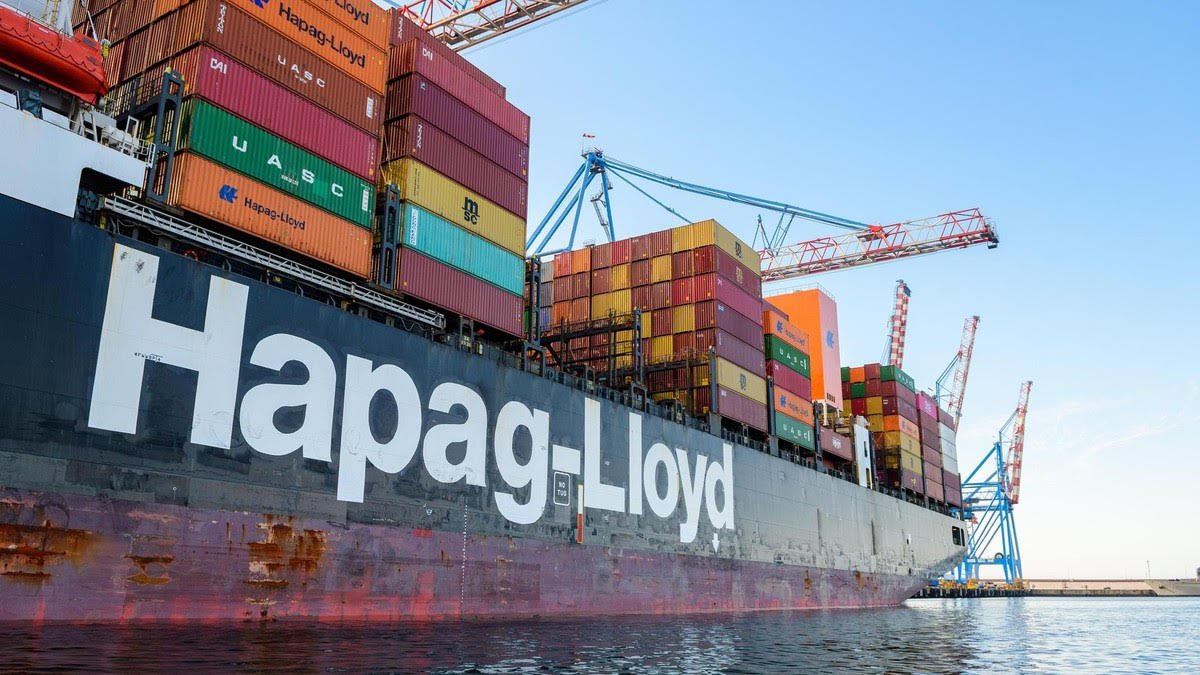
Reports that Mediterranean Shipping Company (MSC) may be exploring the acquisition of a stake in Hapag-Lloyd have reignited discussion over the ownership of Germany’s largest liner operator. The story, first reported by Manager Magazin and subsequently covered by Reuters, has drawn attention not only because of the companies involved, but also because of Hapag-Lloyd’s concentrated shareholder structure.
According to Manager Magazin, MSC founder and chairman Gianluigi Aponte explored the possibility of acquiring shares in Hapag-Lloyd through discussions with the company’s principal shareholders. Reuters subsequently reported that MSC had categorically denied the report, calling it “not true”, while Hapag-Lloyd declined to comment on market speculation.
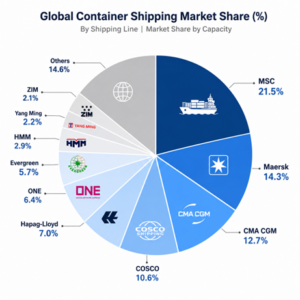
In terms of global market standing, Mediterranean Shipping Company (MSC) already holds the n.1 position as the absolute largest ocean carrier in the world (21.5% market share and an active fleet size exceeding 7.3 million TEU), whereas Hapag-Lloyd ranks as the 5th largest global container line, capturing 7.0% of the market, and operating a fleet capacity of roughly 2.38 million TEU. In addition, Hapag-Lloyd signed a definitive agreement to acquire ZIM in a deal valued at over $4 billion at the beginning of 2026. Once the acquisition receives final regulatory approvals later this year, ZIM’s fleet will integrate directly into Hapag-Lloyd, boosting the global market share of the Geman liner to roughly 9%.
The reports of the potential takeover have also underlined how the composition of Hapag-Lloyd’s shareholder base could play a role in case of potential takeover. According to the company’s latest shareholder information, Compañía Sud Americana de Vapores (CSAV) and entrepreneur Klaus-Michael Kühne each hold approximately 30% of the company’s shares. The City of Hamburg, through HGV, owns 13.9%, while the Qatar Investment Authority and Saudi Arabia’s Public Investment Fund hold approximately 12.3% and 10.2%, respectively. Only a small proportion of the company’s shares remains in free float.
The concentration of ownership means that any change in control would depend primarily on the position of the company’s anchor shareholders rather than on purchases in the public market.
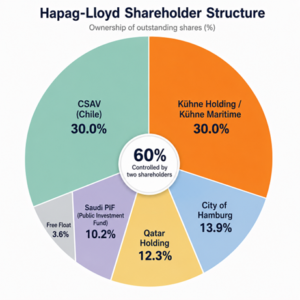
The 3 biggest investors are parties to a shareholders’ agreement originally established following the 2014 merger between Hapag-Lloyd and CSAV. The agreement governs voting rights, board representation and share transfers among the participating shareholders and was extended in 2025 until 2030.
But both major stakeholders will face significant changes in the near future. CSAV is under new management, with some uncertainty whether the new leadership shares the same enthusiasm for shipping as the previous one, while on the other side Klaus-Michael Kühne is very elderly. If he dies, his shares will pass to the foundation, whose succession plan remains unclear.
Although no formal transaction has been announced and MSC has denied the reports, the speculation has drawn renewed attention to Hapag-Lloyd’s structure, as any future change to the strategic shareholders will open new opportunities for takeovers or acquisition.