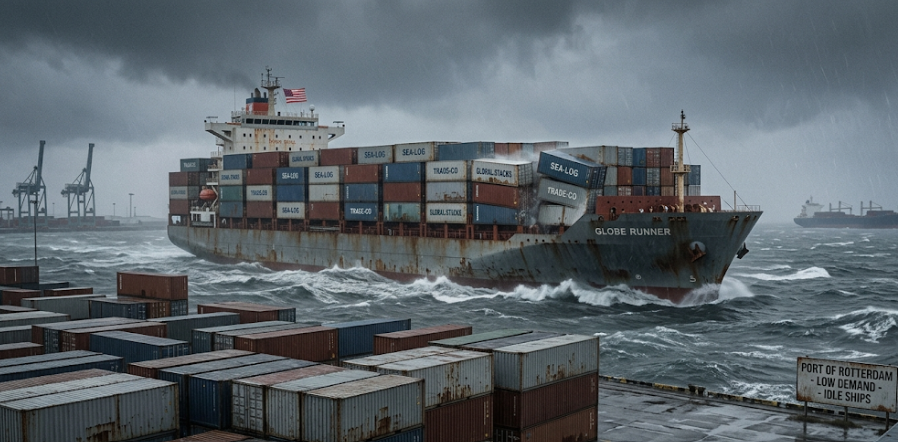
The container shipping industry has entered a phase of strategic recalibration in the first half of 2026. Following the unprecedented volatility of the early 2020s, the sector is now navigating a landscape defined by massive capacity oversupply and a return to normalized demand. Despite ongoing geopolitical disruptions, the market is operating under a regime of strict cost discipline as carriers attempt to prevent a collapse in profitability amidst a “tsunami” of new vessel deliveries.
The contrast between the pandemic-era peak and the current 2026 floor is significant. While rates reached historical highs in 2022, the market has undergone a multi-year correction to reach current levels:
- Indices Collapse: The Shanghai Containerized Freight Index (SCFI) and the Freightos Baltic Index (FBX) have plummeted by more than 70% compared to their COVID-era peaks.
- Rate Stabilization: Spot rates have returned to pre-pandemic levels, settling between $1,500 and $2,500 per FEU.
- Margin Compression: Operating margins, which reached 40% during pandemic peaks, compressed to single digits or were nearly wiped out during the first half of 2026.
Typically, logistical crises that force longer transit routes—such as the ongoing necessity to bypass the Suez Canal for the Cape of Good Hope—lead to a spike in rates. However, 2026 is showing a countertrend where rates trend lower despite these disruptions. The primary driver is a massive influx of new tonnage:
- The 2024–2025 Delivery Peak: The market absorbed a staggering amount of capacity over the last two years. In 2024, the industry took delivery of 473 ships totaling 2,934,402 TEU. This was followed in 2025 by another 284 ships adding 2,312,708 TEU.
- Fleet Expansion Projections: The global cellular fleet capacity, which sat at 27.9M TEU at the end of 2023, is projected to reach 35.1M TEU by the end of 2026.
- Vessel Upsizing: The average ship size in the world fleet has climbed steadily, reaching 5,290 TEU in 2025 and projected to hit 5,390 TEU by the end of 2026.
Financial performance in the late 2025 and early 2026 periods reveals a core Liner business struggling with margin compression. Carriers have pivoted toward radical efficiency measures to offset rising operational costs:
- Slow Steaming: Average vessel speeds across the global fleet have dropped from pandemic peaks of 16.7 knots to approximately 15.5 knots in early 2026 as carriers seek to reduce bunker fuel consumption.
- Maersk Financials: Maersk’s average rate per TEU in its Ocean segment stood at $1,122 in 3Q 2025, a sharp decline from $1,618 a year prior.
- ONE Performance: Ocean Network Express (ONE) reported a net profit of $285 million in 3Q 2025, down significantly from its historical highs but showing recovery from a 2Q 2025 low of $86 million.
- Scrapping Trends: While scrapping was minimal during the boom, estimates for 2026 suggest an acceleration to 400,000 TEU in demolitions as carriers purge older, less efficient units.
A defining trend of 2026 is the role of non-liner revenue in maintaining corporate stability. Carriers that expanded into logistics and terminals have found a crucial buffer:
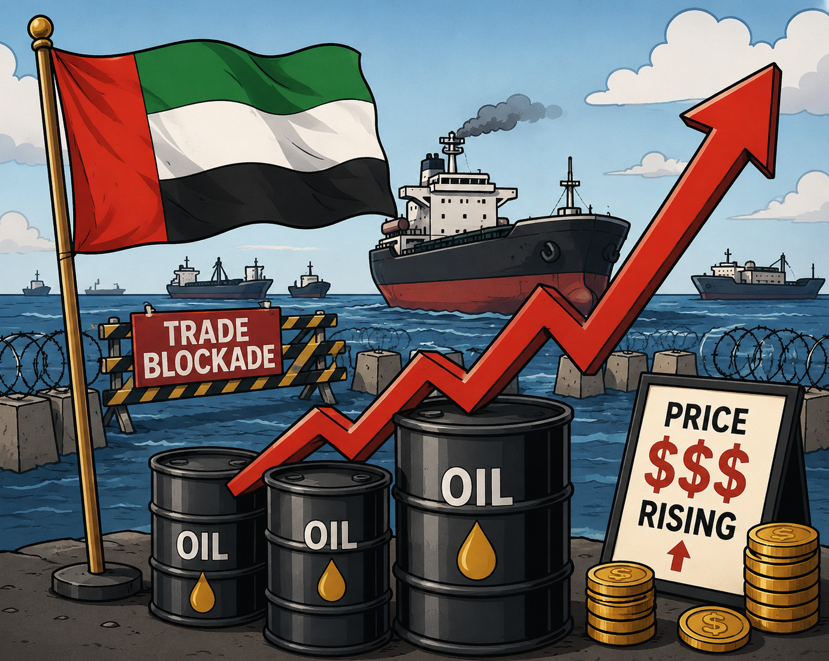
Geopolitical instability continues to immobilize segments of the global fleet. Beyond the Red Sea, the Strait of Hormuz remains a focal point of concern in 2026. As of late 2025, approximately 111 units were categorized as “Idle,” with an additional 56 units listed as “Other/Unassigned,” partly due to vessels being immobilized by regional tensions.
Forward-Looking Outlook
The remainder of 2026 will be defined by capacity management. If the Red Sea routes were to normalize and the Suez Canal reopened fully, the industry would likely face a secondary “supply shock.” Diverted vessels returning to shorter standard routes would create an instantaneous surplus of effective capacity, potentially driving freight rates below sustainable break-even points. For now, the “integrator” strategy and disciplined slow steaming are the only tools keeping the industry’s head above water.
How do you think the potential reopening of the Suez Canal would specifically impact the current delivery schedules for the massive orderbook of ships over 18,000 TEU?