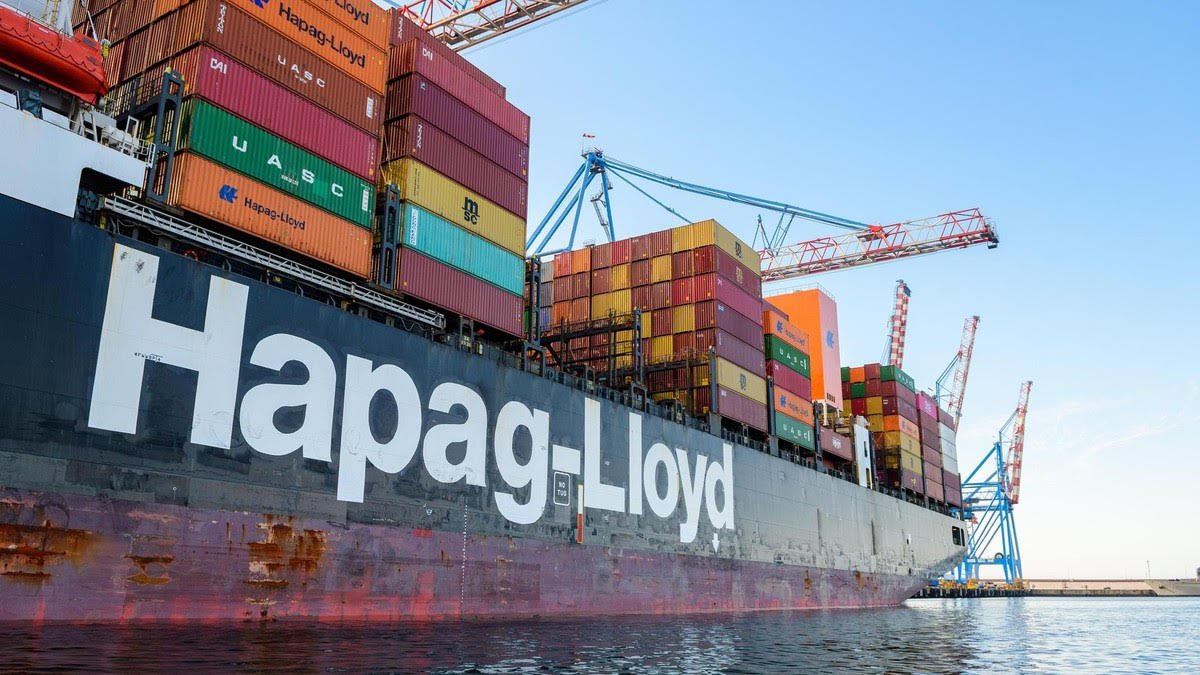
For decades, Dubai has established itself as the commercial gateway to the Middle East. At the heart of this success lies Jebel Ali Port, operated by DP World, which has evolved into the region’s largest container hub and one of the world’s leading transshipment centres.
The success of Jebel Ali, however, has always rested upon a strategic assumption: uninterrupted navigation through the Strait of Hormuz.
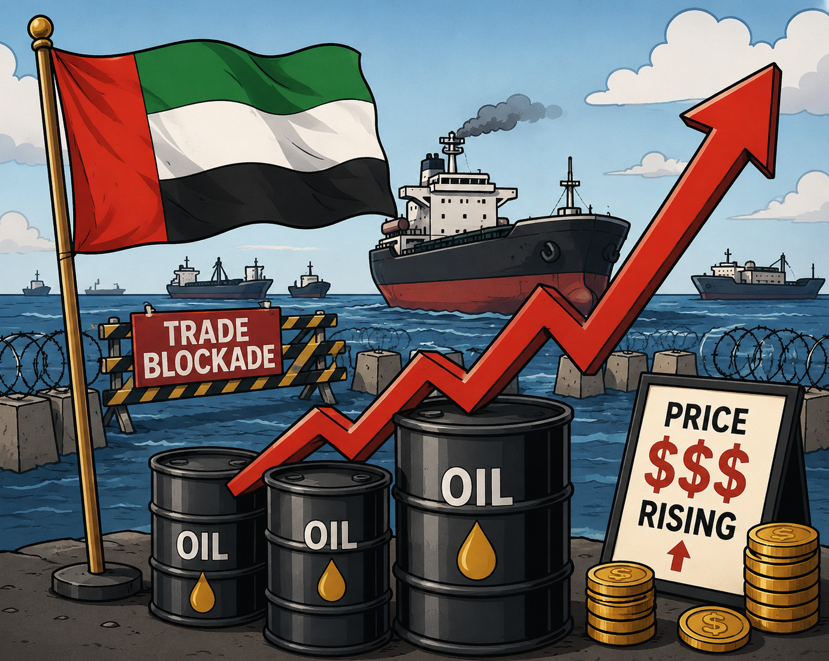
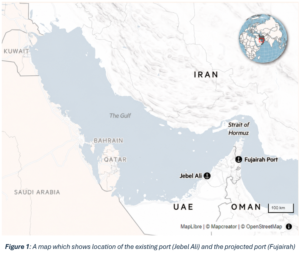
Recent geopolitical tensions have challenged that assumption. Escalating regional instability has exposed the vulnerability of global trade routes crossing the narrow waterway connecting the Persian Gulf with the Gulf of Oman. In response, DP World is reportedly planning a major logistics expansion centred on Fujairah, allowing maritime cargo and energy exports to bypass Hormuz entirely by entering directly from the Indian Ocean.
This project is not merely another port investment. It is a strategic transformation of the UAE’s, which stands for United Arab Emirates, maritime infrastructure and a reorganization of DP World’s port assets in order to cope with critical situations.
Nowadays we must deal with an important topic, summarized as follows: “From Efficiency to Resilience”.
For the last six decades, maritime logistics has been driven by economies of scale. Container shipping concentrated cargo in mega-hubs, while supply chains prioritized cost minimization through just-in-time operations and highly integrated transport networks.
However, recent global disruptions, including the COVID-19 pandemic, the Red Sea crisis, and heightened tensions in the Gulf, have fundamentally altered corporate and governmental priorities.
Today, resilience has become an economic asset; rather than asking: “What is the cheapest logistics solution?”, governments increasingly ask: “What happens if our primary gateway suddenly becomes inaccessible?”
The Fujairah strategy established by DP World is a direct answer to this kind of questions.
The Strait of Hormuz is undoubtly one of the most important maritime junction. Roughly one-fifth of global oil consumption and a substantial share of the world’s LNG exports pass through this narrow corridor every day. Any disruption immediately reverberates through shipping markets, freight rates, insurance premiums, and global energy prices which represents a single-point failure within the global maritime system.
For Dubai, whose principal commercial gateway lies inside the Persian Gulf, this dependence creates structural exposure, that’s why the Fujairah represents a competitive advantage based on geographical strategy.
Unlike Jebel Ali, Fujairah is located on the UAE’s eastern coastline, directly facing the Gulf of Oman. Its position outside the Strait of Hormuz allows vessels arriving from Asia, East Africa, and Europe to reach the port without entering the Persian Gulf.
This geographical distinction transforms Fujairah into one of the most strategically valuable logistics locations in the Middle East.
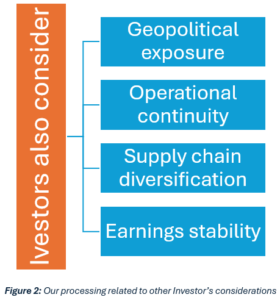
Projects such as Fujairah reduce tail risk, low-probability but high-impact events, capable of significantly affecting revenues.
Although constructing new terminals, pipelines, and inland logistics corridors requires substantial capital expenditure “CAPEX”, these investments may ultimately reduce future volatility in cash flows.
Consequently, DP World’s strategy can be interpreted not simply as infrastructure expansion but as a long-term risk management investment designed to strengthen both operational resilience and investor confidence.
However, this project extends well beyond container shipping since Hormuz is the most important supply route for energetic products throughout the entire world.
The UAE has pursued energy diversification for more than a decade through investments in pipelines connecting inland oil fields with Fujairah.
The objective is clear: “to ensure that crude oil exports remain operational even during a disruption in the Strait of Hormuz”.
Rather than operating independently, these assets function as components of a unified national supply chain by enhancing “Energy Security” and “Integrated Logistics”.
Now the question is, which are the benefits for Global Shipping due to this new paradigm?
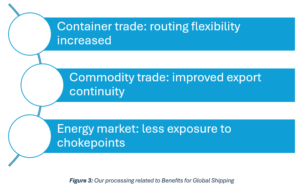
Although Hormuz will remain indispensable for many Gulf producers, the UAE is positioning itself as one of the few regional economies capable of maintaining a relatively high degree of export continuity during future crises.
In this sense, DP World’s strategy resembles the evolution of Singapore’s logistics model, where multiple terminals, integrated transport infrastructure, and strategic redundancy collectively enhance national competitiveness.
The objective is no longer merely to operate the largest port rather than building the most resilient logistics ecosystem.
To sum up, in an era where maritime chokepoints have become central to global economic security, the UAE is not simply building another port, it is redesigning the architecture of resilience for international trade.
References
DP World | End-to-End Supply Chain Solutions | Global Trade
Reuters | Breaking International News & Views