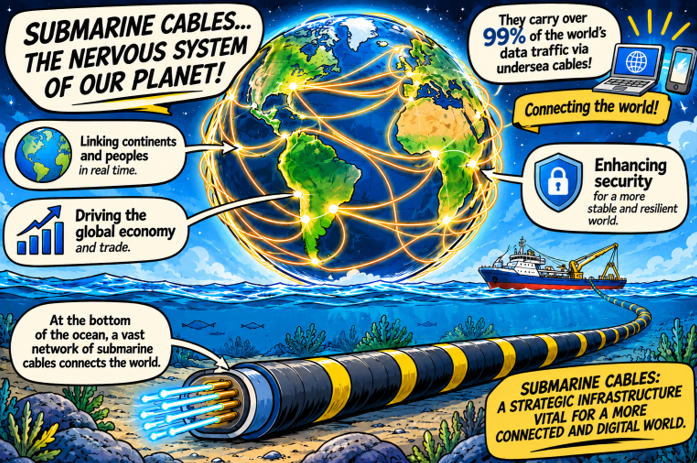
For decades, maritime security has focused on safe navigation, shipping lanes and energy supplies. Although, beneath the sea lies another critical network: the submarine infrastructure.
According to European Commission, fibre-optic cables carry around 99% of intercontinental data traffic, supporting financial transactions, communications and government services. Interconnectors and pipelines are equally important to energy security, also due to the difficulty in monitoring them and costly to repair in case of damage or even worse sabotage.
After several incidents in the Baltic, mainly attributed to Chinese vessels or belonging to the Russian “Shadow Fleet”, have challenged the assumption that the seabed is a protected environment. The question is no longer only how to secure maritime routes, but how to protect the invisible systems sustaining global trade and lives.
The strategic shift can be summarized as: “From Freedom of Navigation to Infrastructure Protection”.
The United Nations Convention on the Law of the Sea (UNCLOS) balances coastal State rights with the freedoms of other States. Articles 58, 79 and 87 protect the right to lay and maintain submarine cables, while Article 113 requires States to criminalize certain intentional or culpably negligent damage to cables and pipelines.
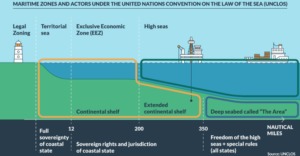 Figure 1: UNCLOS ’82, the maritime zones
However, these rules are not designed for this kind of topic since were developed in a different technological context and those paradigms weren’t already known. They do not provide a complete framework for hybrid threats, cyber interference or coordinated attacks.
The main difficulty is jurisdiction. Within territorial waters, coastal States exercise sovereignty, subject to international law. In the exclusive economic zone and on the high seas, other States retain important freedoms, including navigation. A coastal State cannot automatically stop or board a foreign vessel simply because it appears suspicious near a cable.
This creates a gap between strategic importance and available enforcement powers. It is also difficult to distinguish accidents from deliberate acts and attribute responsibility to a State.
Governments are beginning to respond. On 22nd of October 2026, the United Kingdom published a White Paper proposing updated legislation, including new offences, security duties for operators and government powers to address national security risks. The proposals cover physical and cyber interference but are not yet law.
At European level, the Commission’s Cable Security Toolbox, presented in February 2026, promotes prevention, detection, response, recovery and deterrence. The EU also allocated €347 million to strategic cable projects, including support for repair capacity.
For operators and investors, infrastructure protection is becoming a condition for operational continuity, digital reliability and energy security. Everything already said led to a simple concept: “Rapid repair can be as important as prevention”.
What does this new paradigm mean for global shipping?
“Maritime security”: stronger coordination between coastal States, flag States and operators.
“Legal certainty”: clearer procedures for jurisdiction and responsibility.
“Supply chain resilience”: faster repairs and reduced exposure to disruption.
“Strategic stability”: better cooperation without undermining freedom of navigation.
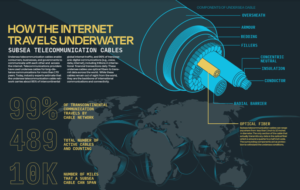 Figure 2: How maritime cables are made (Source: https://www.behance.net/gallery/158505977/How-the-Internet-Travels-Underwater)
UNCLOS remains the foundation, but its application must be adapted to every situation, including the new one regarding submarine cables. Cooperation, consistent national laws and information-sharing are essential, while navigational freedoms must be respected: suspicion alone is not proof of wrongdoing.
To sum up, as digital connectivity and energy security increasingly depend on assets hidden beneath the oceans, protecting submarine infrastructure has become a central dimension of maritime security. The objective is no longer merely to safeguard freedom of navigation, but to build a legal and operational framework capable of protecting the foundations of the global economy.
References
- UNCLOS (1982), Articles 58, 79, 87 and 113.
- UK Government, Critical Undersea Infrastructure Security and Resilience, 22 October 2026.
- European Commission, Submarine Cable Security Toolbox, 5 February 2026.
- Z. Jaffal, Safeguarding Global Connectivity, Ocean Development & International Law, 2026.
- https://www.reuters.com/world/europe/nato-allies-foil-russian-subsea-cable-sabotage-plot-2026-09-10/
- https://digital-strategy.ec.europa.eu/en/factpages/joint-communication-strengthen-security-and-resilience-submarine-cables